

Product
제품
-
Analytical Products
- Wyatt Technology
- Awareness Technology
- Eurofins l Abraxis (GSD)
- Aurora Biomed
- Cifga
- Chrom Tech
- Eichrom Technologies
- EPROGEN
- EIT International
- Fianovis
- Globe Scientific
- GENERON
- Hygiena International
- Halo Labs
- InProcess-LSP
- KROMATON
- Kura Biotech
- MTC Bio
- MZ-Analysentechnik
- Newomics Inc.
- Occhio Instruments
- Optimize Technologies
- Pickering Laboratories
- PolyLC
- Raykol Group
- RheoSense
- Rocker Scientific
- Santai Science
- SEDERE
- Spectra Analysis
- Spectradyne
- UCT
- Wealtec Corp
- Watrex
-
Bio & Medical Products
- A&A Biotechnology
- Accegen Biotechnology
- Adooq Bioscience
- Anaerobe Systems (Biolog)
- Anatrace
- Array Bridge
- Biolog Inc
- Biogenes GmbH
- BioServ UK
- Biomiga
- BioQuochem
- Biotech Support Group
- CinderBio
- Creative Biolabs
- Creative Diagnostics
- Creative Biostructure
- Creative Biomart
- Creative Enzymes
- EICOM
- Emulseo
- GLYcoDiag
- Fluidic Science
- Helix Biotech
- ImmunoChemistry Technologies
- InnoGenomics
- IsoSciences, LLC
- IUL Instruments
- Micropore Technologies
- Molecular Depot
- MicroProtein Technologies
- Matrix Innovation
- Perfinity Biosciences
- PreciGenome
- PhylumTech
- ProFoldin
- Protein Ark
- ProteoChem
- RareCyte
- RECIPE
- Ramona Optics
- Silicycle Inc.
- Sphere Bio
- Tymora Analytical
- UTAK
- YouSeq
- Vesiculab
- Z Biotech

- HemoVoid™ LC-MS On-Bead
- 제품명: HemoVoid™ LC-MS On-Bead
- 용도: Hemoglobin Removal with On-Bead Digestion for Proteomics
- 메이커: Biotech Support Group
- 카달로그:
소개
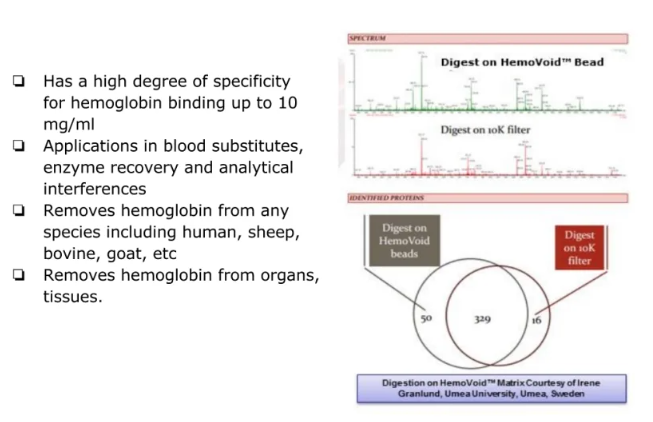
HemoVoid™ LC-MS On-Bead 는 기본적으로 on-bead digestion 기반 LC-MS workflow 를 위해 설계되어 있어, elution buffer 는 기본 구성품에 포함되어 있지 않습니다. 따라서 일반적인 사용에서는 비드에 결합된 단백질을 그대로 유지한 상태에서 다음 단계의 on-bead digesion 을 진행합니다. 다만, 다른 proteomic 분석이나 별도의 소화 방식을 원할 경우에는 (0.25 M Tris + 0.5 M NaCl, pH 9-10) 조성의 elution buffer 를 별도로 준비하여 선택적으로 용출할 수 있습니다.
제품 특징
- • 헤모글로빈 95% 이상 제거
- • 동일 비드 상에서 저농도 단백질 농축 및 트립신 digesion 가능
- • 30분 이내의 간단한 마이크로원심분리 프로토콜
- • 추가 소화·탈염 단계 없는 간소화된 워크플로우
- • iTRAQ 및 label-free LC-MS 와 호환
- • Discovery 및 targeted proteomics 에 적합
실험 과정
1. 비드 준비: 비드를 binding buffer로 평형화
2. 시료 결합: RBC lysate 를 비드와 반응시켜 헤모글로빈은 배제하고 저농도 단백질 분획을 농축
3. 원심 분리: 비드와 비결합 분획을 분리하고 flow-through 회수
4. 세척 2회: 비특이적 결합 성분 제거 및 분리 효율 향상
5. On-bead Digesion: 기본 workflow 는 on-bead digesion 이며, 필요시 별도 준비한 elution buffer로 용출 가능
6. 환원 및 알킬화: 단백질 digestion 를 위한 전처리
7. 트립신 digesion: 비드에 결합된 단백질을 펩타이드로 분해
8. 펩타이드 회수 및 추가 추출물: 소화된 펩타이드 회수 및 잔여 펩타이드 추가 추출
9. LC-MS/MS 분석: 최종 펩타이드 분획을 LC-MS/MS에 적용
주문정보


관련자료